When I was four, my mother left me alone in a church, gently smiling as she whispered, “Don’t worry. God will take care of you.” Then she disappeared.
Twenty years later, she came back to my life in tears, grabbed my hands, and said, “We need you.” I wanted to know why she had suddenly returned after abandoning me as a child. But when I finally discovered the real reason, I wished I had walked away without ever asking.
The Bench Beneath Colored Glass
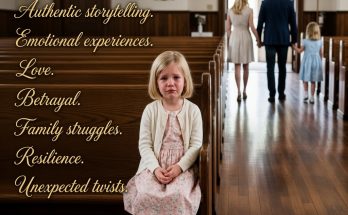
I was only four when my mother led me into a quiet church and guided me onto a smooth wooden pew. Sunlight poured through tall stained-glass windows, casting soft colors across the floor. She straightened the collar of my little gray coat with calm, careful hands, as if this were just another ordinary day.
Then she leaned in and whispered, “Stay here, Nora. God will watch over you.”
Before I could even respond, she stood up. My father took her hand. My older brother followed.
And just like that… they walked away.
No hesitation. No explanation.
I remember my feet dangling above the floor, my mind too confused to process what was happening. I didn’t cry. I didn’t understand that, in that moment, my life had quietly split into a before and an after.
The faint scent of candle wax filled the air. Voices echoed somewhere in the distance. My mother turned back once, offering a soft, peaceful smile that made no sense then—and even less now.
It was the smile of someone who had already decided I no longer belonged to her.
The doors opened.
A rush of cold air slipped inside.
And they were gone.
The Woman Who Stayed
A nun found me first. Then a priest. Eventually, a social worker.
There was no note. No name. No explanation.
Only fragments surfaced over time—quiet conversations between adults who spoke carefully, as if the full truth might shatter something fragile. My parents had vanished without a trace.
Months later, I was placed with Florence Miller.
She was nearly sixty, living alone in a small home filled with books and the soft scent of lavender. She worked as a church pianist, her fingers sometimes stiff with pain, but her presence steady and warm.
Florence never tried to rewrite my past.
She didn’t cover the silence with comforting lies.
Instead, she gave me honesty—slowly, gently, in pieces I could carry.
“Some people leave because they’re overwhelmed,” she once told me while clumsily braiding my hair. “Some leave because they’re unkind. And some leave because they’re afraid to face themselves.”
She paused, then added softly, “But none of that is ever the child’s fault.”
She stayed—in every way that mattered.
Packed lunches. School meetings. Quiet evenings. Constant care.
And over time, the memory of that church bench stopped feeling so sharp.
A Life I Built on My Own
As I grew older, I stopped waiting for answers that would never come.
Florence had taught me something more valuable: stability isn’t something you find—it’s something you create.
I focused on school. Kept my life simple. Eventually, I earned a scholarship to a small Catholic college.
Returning to that same church didn’t reopen the wound the way I feared. Instead, it felt different—grounded. What had once been a place of abandonment slowly became a place of peace.
By twenty-four, I was working there as a parish outreach coordinator—organizing food drives, helping families in need, running programs for children. And when Florence’s hands hurt too much to play, I would sit at the piano in her place.
It wasn’t a grand life.
But it was mine.
And for the first time, I understood what it meant to belong somewhere without fear.
The Day They Returned
It was a rainy afternoon in October—exactly twenty years after the day I was left behind—when the doors of Saint Thomas Aquinas opened once again.
Three people stepped inside.
Older. Changed.
But unmistakable.
They walked toward me as if no time had passed at all.
Part 2 of 3
My mother’s eyes filled with tears—too quickly, too perfectly—and she said, “We’re your family, Nora. We’ve come to take you home.”
For a split second, everything collapsed inward.
I was four again.
Frozen.
Watching them walk away.
But then Florence’s voice echoed in my mind:
Not everyone comes back because they love you. Sometimes… they come back because they need something.
And just like that—I understood.
PART 2: What They Really Wanted
I didn’t speak right away.
The silence unsettled her.
My father cleared his throat. “You’ve grown into an incredible young woman, Nora.”
My brother stood behind them, tense, watching me with something between guilt and curiosity.
“Why are you here?” I asked.
My mother stepped forward. “We’ve regretted everything. Every single day.”
The words felt hollow. Practiced.
Then she pulled out a photograph.
A young girl in a hospital bed. Pale. Weak.
“This is your niece, Hannah,” she said softly. “She needs help.”
Everything clicked into place.
“You want me tested,” I said.
Relief flickered across her face. “We want to be a family again.”
I held her gaze.
“No,” I said calmly. “You want something from me.”
The shift in the room was immediate…
The soft, rehearsed grief in my mother’s posture gave way to something colder, sharper, and far more familiar to the core of who she really was.
“Nora, please,” she said, her voice dropping the frantic quaver and taking on a tight, desperate urgency. “She’s six years old. She has acute myeloid leukemia. The treatments aren’t working anymore. The doctors say her only real chance is a bone marrow transplant, and none of us are a full match. Not me, not your father, not your brother.”
“So you remembered you had another child,” I said. The words tasted like iron in my mouth. “A spare part left on a wooden pew twenty years ago.”
My father took a step forward, his jaw set in a line of defensive pride. “We didn’t leave you out of malice, Nora. You don’t know what our lives were like back then. We were bankrupt. We were drowning. We could barely feed your brother. We thought… we truly believed we were giving you a chance at a better life with people who could afford you.”
“You left a four-year-old on a bench,” I replied, my voice steady, though my pulse roared in my ears. “You didn’t walk me to a police station. You didn’t hand me to a social worker. You left me like a coat someone forgot on a bus, hoping the universe would sort it out so you wouldn’t have to carry the guilt of answering questions.”
My brother, who had remained silent near the holy water font at the back, finally looked up. His eyes were red-rimmed, heavy with a shame that seemed far more genuine than our parents’ carefully constructed agony. “Nora,” he rasped. “I was eight when they took you away. I didn’t know what they were doing until we were three blocks gone. I asked about you every day. But Hannah… Hannah is my daughter. She didn’t do any of this to you. She’s just a little girl who wants to live.”
That was the twist of the knife. They hadn’t come to fix a broken family; they had come to salvage the one they chose to keep. And they were using an innocent child as the hammer to break down my walls.
“I need to think,” I whispered.
“We don’t have weeks, Nora,” my mother pressed, reaching out to touch my arm.
I pulled back before her fingers could graze my sleeve. “Do not touch me. Leave Saint Thomas Aquinas. Leave your phone number with the parish secretary. If I decide to be tested, you will hear from a coordinator at the hospital. Not from me.”
The Price of Mercy
That evening, the rain beat a relentless rhythm against the leaded glass of Florence’s small sunroom. The house smelled of boiled tea, dried lavender, and the old paper of her endless library.
I sat on the worn Ottoman beside her armchair, my face buried in my hands. Florence sat quietly, her arthritic fingers slowly turning the pages of an old hymnbook she no longer needed to read to know by heart.
“You don’t owe them your body, Nora,” Florence said softly, breaking the long silence. “You don’t owe them forgiveness, and you certainly don’t owe them reconciliation.”
“It’s not for them,” I said, looking up. My eyes burned. “I looked at that picture, Florence. Hannah has the same downturned eyes I see in the mirror every morning. She’s six. She didn’t choose those people as her parents any more than I did. If I say no to spite them, am I any better than she was when she walked out those double doors?”
Florence placed her heavy, warm hand over mine. Her skin was thin as parchment, her knuckles swollen, but her hold was the strongest thing in my world. “Mercy that costs you your integrity isn’t mercy—it’s surrender. But if you give help because your heart demands it, not because their guilt demands it, then it isn’t surrender. It’s an act of grace. Just make sure you draw the line between the niece who needs you and the ghost family that wants to consume you.”
Two days later, I drove to the university medical center. I registered as an anonymous donor candidate for Hannah Vance. I signed non-disclosure agreements. I explicitly forbade the hospital staff from sharing my contact details, my address, or my personal medical status with my biological family. The testing was painful—needles, marrow aspirates, endless vials of blood—but physical pain was simple compared to the knot tightening in my chest.
A week later, the call came.
“You’re a full match, Nora,” the transplant coordinator told me. “It’s rare, but your HLA markers are almost identical. We can schedule the harvest for next month.”
“Do it,” I said.
“Have you spoken with the family?”
“No,” I replied firmly. “And I don’t intend to.”
The Unraveling
The weeks leading up to the procedure were an exercise in psychological warfare. My biological family didn’t respect the boundaries I had set through the hospital. My brother began waiting outside Saint Thomas Aquinas after the evening services.
One Tuesday night, as the autumn fog rolled off the river, he approached me near the parish hall steps.
“Nora, please, just let us buy you dinner,” he begged, holding up his hands to show he meant no harm. “Mom and Dad are losing their minds. They want to make this right. They want you at Hannah’s bed when the transplant happens.”
“Why, Leo?” I asked, using his name for the first time. It felt strange and foreign on my tongue. “So you can take a family photo? So you can put twenty years of abandonment into a neat little box with a ribbon on top and pretend you’re good people?”
“They’re afraid!” he yelled, his composure snapping under the weight of his anxiety. “They’re terrified that you’ll change your mind at the last second and let my daughter die just to punish them!”
I stopped in my tracks and turned to face him. The porch light of the church cast sharp shadows across his face.
“If I wanted to punish them, I would have said no on day one,” I said, my voice dangerously low. “I am doing this procedure. I have already signed the surgical consents. But I am doing it for a child who deserves a life, not for parents who threw theirs away when it became inconvenient. Tell them to stop coming here. Tell them that every time they try to force their way into my life, they remind me exactly why I am glad Florence raised me instead of them.”
He flinched as if struck. For a moment, the heavy air between us carried the faint, ghostly weight of the childhood we should have shared—playing in backyards, fighting over toys, growing up together. But that potential had been murdered twenty years ago on a wooden pew.
“I’m sorry,” Leo whispered, taking a step back into the dark. “I really am, Nora.”
“I know you are,” I said softly. “But sorry doesn’t rewrite twenty years.”
The Glass and the Blood
The day of the procedure arrived in late November. The sky was the color of wet slate. Florence drove me to the surgical center early in the morning, her steady presence a fortress against the cold, clinical reality of the hospital room.
Before they wheeled me into the operating theater to harvest the marrow from my pelvic bone, a nurse handed me an envelope.
“The family asked if you would read this before surgery,” she said gently.
I took the letter. Inside was a hand-written note from my mother, written in slanted, trembling script:
Nora, We know we don’t deserve this. We know we can never make up for the bench, for the cold, for the years we missed. But today, you are giving us a second chance at a family. When Hannah recovers, we want you home. The room upstairs is yours. We saved all your old things. Please, let us be your parents again.
I stared at the paper. There was no mention of Florence. No acknowledgment of the woman who had wiped my tears, cooked my meals, taught me to play the piano, and built a human being out of the shattered pieces they had discarded. To my mother, those twenty years were just an unpleasant pause in her story—a mistake to be erased so she could feel whole again.
I folded the paper carefully, handed it back to the nurse, and said, “Please throw this in the biohazard bin.”
The surgery was exhausting. When I woke up in the recovery ward, my lower back felt as if it had been struck by an iron bar, a deep, bone-deep ache that made every breath a calculated effort. But through the fog of anesthesia, I felt an extraordinary, quiet clarity.
Two floors above me, my marrow was being infused into a six-year-old girl’s veins. My blood was giving her a immune system. I had given her a future.
Later that afternoon, against medical advice, I asked a nurse to wheel me up to the pediatric oncology ward. I didn’t want a scene. I didn’t want tears or dramatic reunions. I just wanted to see.
Through the small window of Isolation Room 402, I saw her. Little Hannah lay hooked up to monitors, a colorful knit cap covering her hairless head. Sitting on the far side of the bed were my parents and my brother, their eyes glued to the IV pole where my life was slowly dripping into her veins. They looked old, broken, and consumed by the very anxiety they had tried so hard to escape twenty years ago.
They had lived two decades running from their cowardice, only to be brought to their knees by it. They were bound together by trauma, guilt, and desperation.
Then I looked at my own reflection in the glass panel of the door.
I was pale, bruised, and sore. But behind me, standing patiently in the corridor with a warm blanket and a thermos of soup, was Florence.
I realized then that family isn’t the blood that runs through your veins or the marrow hidden inside your bones. Family is the choice to stay when leaving is easy. It is the steady hand in the darkness, the quiet presence on an ordinary Tuesday, the woman who took a abandoned four-year-old and taught her how to stand tall.
My biological parents had given me life, and then they had abandoned it. I had given their granddaughter life back, and now the ledger was balanced. The debt was settled forever.
I turned my wheelchair around, looking away from the glass.
“Ready to go home, Florence?” I asked.
Florence smiled, her eyes crinkling with a warmth that filled the sterile hospital corridor with the scent of lavender and old books. She took the handles of my wheelchair and turned us toward the exit.
“Let’s go home, Nora,” she said softly. “The tea is already made.”
We walked out into the cold November evening together. Behind us, the hospital doors slid closed, sealing away the past. Ahead of us lay the life I had chosen, the peace I had built, and the only family I would ever need.