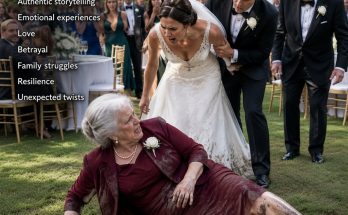
I married my 79-year-old neighbor knowing money was part of the deal. A year later, I learned the fortune had never existed, but the worn bag she left behind presented me with something far harder to walk away from.
I was thirty-one when I bought the worst house on Alder Street. I got it cheap, and I told myself the bones were good.
Here’s how it went.
The kitchen faucet leaked, so I pulled it out to fix it. Behind the wall, the pipes looked like something you’d dig up from a shipwreck.
Here’s how it went.
Then a brown stain bloomed on the ceiling, and the roof turned out to be a bigger problem than the faucet ever was.
Every fix opened a new wound.
I learned to solder, to patch drywall, and to swear quietly so the neighbors wouldn’t hear.
Half the house stayed unfinished, and I got used to walking past bare studs like they were furniture.
Then Margaret moved in next door.
Every fix opened a new wound.
She was seventy-nine, small, and sharp as a tack. Most neighbors I’d known gave me a nod and nothing more.
Margaret walked over on her second day with a hand out.
“You’re Frank? You look like a man who owns a lot of tools.”
“I own a lot of problems,” I said. “The tools come with them.”
She laughed, a dry little crackle. I carried her groceries that week.
“I own a lot of problems,”
Her gate hung crooked on one hinge, and I fixed it in ten minutes because I was already in work mode. She watched me from the porch.
“Nobody asked you to do that.”
“It was crooked. It bothered me.”
“Sit. I’ll make coffee.”
That’s how it started. Coffee turned into evenings, and evenings turned into months.
“Nobody asked you to do that.”
She told me about the piano she’d never learned and the men she’d sent packing. I told her about my pipes.
She lived alone, and I became the guy she called when a lightbulb died or a jar wouldn’t open. I never asked for a dime. Why would I? She was my friend.
Then one evening, the porch light was buzzing with moths, and she set her cup down.
“Frank, if I asked you to marry me, would you?”
I became the guy she called
I laughed so hard I nearly spilled my coffee. “Margaret, I’d have to check with my pipes.”
She didn’t laugh. She looked at me steadily.
“You’d inherit everything when I’m gone.”
Now, I’d love to tell you I was too decent for that. But I’d just spent that week staring at a plumber’s estimate with a number on it I couldn’t pay.
Something in me shifted. Call it greed if you want.
I’d love to tell you I was too decent for that.
I call it what happens when a drowning man sees a rope.
“Okay,” I heard myself say.
***
We married a few weeks later at the courthouse. She wore a green dress and held my arm like she was steadying herself on a rail.
I’d like to say I stayed the same man, but I didn’t.
Call it greed if you want.
I started talking about the future over dinner. MY future.
“I’d fix the roof first,” I said. “Then the pipes. Invest the rest”
Margaret just nodded.
“What about your accounts?” I asked her one night, trying to sound casual. “The property papers? Your will?”
“It’s all taken care of,” she said.
I started talking about the future
She said it the same way every time, gentle and final, like closing a book.
Eventually I stopped asking. I told myself she was old-fashioned and private.
I didn’t think about what it meant that I’d asked at all.
Then her health slipped. It happened slowly, then all at once.
First she got tired on the porch. Then she got dizzy on the stairs. Then came the appointments, and I drove her to every one.
Then her health slipped.
I learned which pills went with breakfast and which went with dinner. I learned to cook soup the way she liked it.
Some nights I stayed in the chair beside her bed because she didn’t like the quiet.
My own house sat unfinished, and I barely looked at it. I was too busy looking at her.
A year after the wedding, Margaret died.
I was too busy looking at her.
The funeral was on a gray Saturday, cold enough that everyone kept their coats buttoned.
I stood at the front and shook hands. People squeezed my arm and murmured things.
“You take care of yourself now, Frank.”
“She left you well set up, I hear.”
I nodded at all of it.
When the crowd thinned, her lawyer stepped up.
The funeral was on a gray Saturday
He was a tall, stooped man with a gray mustache and a face like a closed door.
“Frank,” he said quietly. “I need you to stay for a while.”
We stood by the cars while the last mourners drifted off. He reached into his coat and handed me a small leather bag.
It was worn soft, the color of old tea.
I frowned. “What’s this?”
“I need you to stay for a while.”
He looked me straight in the eye.
“The truth is, she was bankrupt. She left you only this bag.”
A year of soup, pill schedules, and sitting up in the dark tipped over in one sentence. Bankrupt. There was no fortune. There never had been.
She had looked me in the face and lied, and I had believed her because I wanted to.
“You’re telling me she tricked me,” I said. “It was all a lie? Why would she do this to me?”
“She left you only this bag.”
“I’m telling you what’s in the file.” He didn’t blink. “The rest is in the bag.”
I opened it slowly, expecting a joke.
Inside was an antique brooch in a dented old case. My eyes went wide when I saw it.
Under it lay a photograph, an address on a slip of paper, and a letter folded in thirds.
I read it in my truck with the heater running.
“The rest is in the bag.”
She didn’t dress it up.
There was never a fortune, Frank. I lied because there’s something I need you to do for me.
The woman in the photo is my sister, Evelyn. We were young in that picture. Look how she’s laughing. I used to make her laugh.
Then our mother died. Her will didn’t clarify which of us was supposed to receive the brooch that had been handed down in our family, so I took it. Evelyn wanted it, too.
What began as an argument about jewelry became something with no bottom.
I lied because there’s something I need you to do for me.
Evelyn cut me off. Decades went by.
I picked a thing over a person, and I let my pride do the rest. I wrote to Evelyn in later years. She wouldn’t have me. That’s where you come in.
When we first met, you were a kind soul who brought some light back into my life. That’s why I decided to trust you.
But I’ll confess something. After the wedding, I got scared.
That’s where you come in.
You seemed obsessed with the money. I wondered if I’d made a mistake, and if the man I trusted had walked out the moment I opened my purse.
I had to put the pages down for a minute.
Then I read the final lines.
Take the brooch to Evelyn. Make sure she knows I finally admitted that I was wrong. Her address is in the bag.
I lifted the brooch to the light. Then I did what any broke man with a rusty house would do. I drove to an antique jeweler to get the brooch appraised.
I wondered if I’d made a mistake,
***
The jeweler turned the brooch under his lamp for a long time. Then he took the loupe off and looked at me differently.
“Where did you get this?”
“It was my wife’s.”
“It’s a valuable piece. You could easily get eighty-five thousand at auction.”
That number haunted me all the way home.
Take the brooch to Evelyn.
I sat in my driveway with the case on my knee and looked at that sad, half-finished house.
Nothing was stopping me from selling the brooch.
Margaret was dead. Evelyn had no idea I had it. The brooch was legally mine, and nobody could make me return it.
I sat there a long time.
Then I started the truck and drove to the address.
Nothing was stopping me from selling the brooch.
Evelyn’s house was tidy and gray, with a wreath on the door.
I knocked. A woman opened it, thin and straight-backed, with Margaret’s eyes. Those eyes gave me a jolt.
“Yes?”
“My name’s Frank. I was married to Margaret.”
Her face went flat and cold. “Was.”
I drove to the address.
“She passed away last week. I’m sorry.”
She said nothing. I don’t think she flinched at all. Decades of silence don’t crack over one sentence.
“She left something for you,” I said, and I opened the case.
Evelyn looked down. Her whole body went still. Then something came up in her face, and I realized it wasn’t sorrow.
She was furious.
“She left something for you,”
“She sent you to do this?”
“She wanted you to have it back. She regretted what happened. She wanted you to know…”
“She had forty years to knock on my door. She doesn’t get to send a stranger with a box and call it forgiveness.”
“Ma’am, I don’t think that’s…”
“Get out of here!”
“She sent you to do this?”
The door closed.
I stood on the porch holding eighty-five thousand dollars in a dented box.
And I felt an ugly sense of relief.
I’d tried to return the brooch, but she’d refused. Nobody could say I hadn’t done my part. I could go home with a clear conscience and a fixed roof.
I went down the steps. One, two, three.
At the bottom, I stopped.
And I felt an ugly sense of relief.
I pulled Margaret’s letter out of my pocket and looked at it again, and something snagged.
She hadn’t asked me only to deliver jewelry.
She’d asked me to make sure Evelyn knew Margaret finally admitted she was wrong. Evelyn had refused the brooch, but nobody had heard the apology.
So I turned around.
Nobody had heard the apology.
I didn’t knock again.
I’d figured out that another face-to-face would only get me another closed door. Instead, I walked back up and tried the mail slot.
The brooch wouldn’t fit, of course. But the letter would. I folded the pages and fed them through, one stubborn inch at a time.
“Keep the letter,” I called through the slot. “That’s all. Just keep the letter.”
Silence. Then footsteps, and a second voice.
I folded the pages and fed them through
“Just read it.”
“I don’t want to hear another word from her.”
“Mom. Please.”
They argued in low voices. I stood there with my hands in my pockets, feeling like a man waiting outside a courtroom.
Then the arguing stopped. A long quiet followed, and then the door opened.
“I don’t want to hear another word from her.”
Evelyn stood there with the pages in her hand, eyes red.
Beside her was a younger woman with the same jaw and a look like she’d been holding her breath for a year. She had to be Evelyn’s daughter.
“Why couldn’t she say this to my face?” Evelyn whispered.
I didn’t defend Margaret. That wasn’t my job.
I just held out the case once more.
“Why couldn’t she say this to my face?”
This time, her hand came up and closed around it.
“Thank you,” she said, barely audible.
I nodded, because my voice had left. I turned and walked to my truck, figuring that was the end of it.
“Wait!”
The younger woman was running down the walk, a folded envelope flapping in her hand.
“Wait!”
“I’m Claire,” she said, out of breath. “Evelyn’s daughter. Please, wait.”
“You don’t owe me anything.”
“It isn’t that.” She held out the envelope. “Margaret wrote to my mother a year or two ago. Mom recognized the handwriting and wouldn’t open it. Then a few months back, another one came. Mom wouldn’t read that either… so I did.”
“That’s it?” I pointed to the envelope.
“Mom wouldn’t read that either… so I did.”
She nodded.
“She said she was running out of time. She said she’d made arrangements for the brooch. And she wrote about you.”
“About me?”
“I didn’t know if you’d ever come. I almost threw it out.” Claire pressed the envelope into my palm. “Then I watched you turn around at the bottom of those steps. You should read her last letter, Frank.”
“She wrote about you.”
I read it against the side of my truck, with the wind pulling at the corners.
I put money between us. I promised him a fortune, and then I watched that promise change him.
He asked about the accounts. He planned what he’d do with money he didn’t have, and I was frightened I’d misjudged him.
But he never talked that way before I asked him to marry me. And the questions stopped when I got sick.
I watched that promise change him.
He’s been more like his old self these past few days, but I don’t know if that will last once he finds out what I’ve done.
I don’t know which Frank will be standing here when he learns there’s no fortune. He may never make it to your doorstep.
Then came the part I had to read twice.
I don’t know if that will last once he finds out what I’ve done.
I once had to choose between an object worth a great deal and my sister.
I chose the object. It cost me forty years.
The brooch belongs to Frank now. He’ll figure out that it’s worth something. He’ll know exactly what it could do for that house of his, and all I can do is hope the man I trusted is still in there somewhere.
More than anything, I hope he doesn’t repeat my mistake. I hope he doesn’t choose what the brooch is worth over what returning it means.
All I can do is hope the man I trusted is still in there somewhere.
I read the last line and slid down until I was sitting on the curb, the letter shaking in my hands.
She’d trusted me, and I’d almost let her down twice. Worse, she’d known that was a possibility and had left this task to me anyway.
That was the thing I couldn’t get past.
She’d died not knowing what choice I’d make. I looked up at the clear sky and hoped she was up there somewhere, watching me right now.
She’d trusted me, and I’d almost let her down twice.
Claire crouched a few feet away and didn’t say anything.
I was grateful for that.
After a while she held out her hand. I gave her the letter, and she took it back inside so Evelyn could read the rest of her sister’s words.
I drove home slowly, with no fortune and no brooch.
I looked up at the clear sky and hoped she was up there somewhere, watching me right now.
My house sat there in the fading light, roof sagging, paint peeling, just as I’d left it.
I stood in the doorway a minute.
Then I went into the kitchen, where the bare wall still gaped where the pipes had been. I picked up my toolbox.
It was heavier than I remembered, and the handle was warm in my hand.
I got back to work.